Comments Off on What University Leaders Should Look for in a Marketing Partner
Consumer brands built the agency relationship model. It assumes a client who wants marketing produced and an agency that produces it, compensated for output rather than outcomes. That model has served a lot of companies reasonably well. But in higher education enrollment, it produces persistent problems that are causing most university leaders to ask whether the traditional agency structure is still the right model.
What the Traditional Agency Model Gets Wrong About Enrollment
The structural problem with the agency model in higher education is incentive misalignment. An agency compensated for producing marketing activity isn’t structurally accountable for what happens when a prospective student actually engages with that marketing. That activity might include campaigns launched, content created and impressions delivered. What it rarely includes is enrolled students.
This matters more in higher education because the decision timeframe is long and the stakes of a poor student match are high for both institution and student. An agency optimizing for cost-per-lead might produce a lot of leads. Whether those leads become enrolled students who persist to graduation is a separate question that a traditional agency rarely has to answer.
Agencies compensated for leads have no stake in what those leads ultimately cost. UPCEA research puts the average cost per inquiry at $140 and the average cost to enroll one student at $2,900. If your agency contract measures success at the inquiry level, the institution bears every dollar between those two numbers.
A genuine partner is transparent about how your program is performing and why. Not just what the dashboard shows, but what it means. That includes why a particular market is responding well, where competitive pressure is building and what the data suggests about the next six months. Transparency goes beyond reporting too. You’ll see it when an organization treats the institution as a collaborator, not a client to manage.
Skin in the Game
When your partner’s return depends on enrollment performance, it changes their level of commitment. A direct financial interest in keeping your program competitive means they will:
Proactively monitor the competitive and employment landscape
Identify when adjacent concentrations could expand your addressable audience
Surface recommendations without waiting to be asked
A vendor executes what you request. A partner surfaces what you need.
One Coordinated System, Not Separate Functions
The most common failure mode in outsourced enrollment marketing isn’t poor execution in any single area. It’s the gaps between areas: marketing that doesn’t inform student recruitment, enrollment outreach disconnected from student success, no single point of coordination when something isn’t working.
A well-structured partnership addresses this directly. At AllCampus, the marketing lead, enrollment lead and partnership service director assigned to each university operate as a coordinated pod. They share data across functions and problem-solve together. The university’s enrollment team is never left wondering which external party owns a problem, because everyone is accountable for results.
Accountability to Outcomes, Not Activity
This is the hardest characteristic to evaluate from the outside, because every vendor claims they’re accountable for outcomes. The test is in the level of ownership established by both the contract and the work itself. An agency that generates leads but doesn’t handle nurturing cannot fairly be accountable for enrolled students. Accountability follows responsibility. When a partner owns the full journey, the accountability question answers itself.
Who the Strategic Partner Model Is For
Not every institution needs or is ready for a strategic partnership model. The model works best when an institution is investing meaningfully in program growth and needs external expertise to build or accelerate that capability.
It also requires institutional willingness to share data and information. That includes student profile information that helps the partner understand who is enrolling and optimize outreach accordingly.
For institutions primarily looking for campaign execution, a traditional agency relationship may be the right fit. The question to ask is whether your needs are primarily executional or strategic. If the answer is strategic, a vendor relationship will consistently frustrate you. You’ll find yourself managing an agency toward an outcome they’re not contractually accountable for.
To learn more about how AllCampus approaches higher education marketing for online programs, visit our marketing solutions page.
About AllCampus
AllCampus grows enrollment for colleges and universities at a lower cost to serve. AllCampus delivers five core solutions for universities — market intelligence and program strategy, marketing, recruitment, learning design and student success — that support online, hybrid, and campus-based programs across 150+ programs at 30+ partner institutions. Institutions can engage AllCampus across all five areas or focus on the one or two where they need the most support, backed by structured reporting, disciplined operating workflows and measurable enrollment outcomes.
Comments Off on AllCampus Partners with Washington University School of Law
The partnership will support enrollment growth and broaden access to flexible, career-focused online legal education for professionals nationwide.
Chicago (July 21, 2026) –– AllCampus, a leading higher education strategic partner helping top universities and employers solve their biggest academic program and workplace benefit challenges, today announced a new partnership with Washington University School of Law (WashU Law) to support and expand enrollment for the school’s portfolio of online graduate law programs.
Expanding Access to Flexible Legal Education
Through the partnership, WashU Law will continue to deliver flexible, career-focused online legal education designed for a broad range of learners. Programs are tailored for working professionals, internationally trained attorneys, JD holders seeking specialization and non-lawyer professionals interested in developing legal and tax expertise.
WashU Law’s online graduate law offerings include:
Master of Legal Studies (MLS) — A flexible program designed to help professionals build practical legal expertise and confidently navigate complex legal and regulatory environments without becoming practicing attorneys. Students may pursue a general track or select from concentrations including:
AI in the Law, the first of its kind
Business Law
Conflict Resolution
Employment Law
Litigation
Regulatory Compliance
Master of Legal Studies in Taxation (MLS in Taxation) — A specialized program designed for professionals seeking to deepen their understanding of tax law, compliance and evolving regulations without pursuing a JD.
Master of Laws in U.S. Law (LLM in U.S. Law) — An online LLM program tailored for internationally trained attorneys and U.S. lawyers seeking advanced legal expertise and foundational knowledge in U.S. law. Students may also pursue optional concentrations including AI in the Law, Business Law, Employment Law and Regulatory Compliance.
Master of Laws in Taxation (LLM in Taxation) — An advanced taxation-focused program designed for JD holders and practicing attorneys seeking sophisticated technical and analytical tax law expertise.
Supporting Workforce-Relevant Learning
“For more than 150 years, WashU Law has set the standard for academic excellence and innovation in legal education,” said Joe Diamond, CEO at AllCampus. “We’re proud to partner with one of the top law schools in the country that is also committed to expanding access to high quality, flexible online programs that meet the evolving needs of today’s learners and employers.”
WashU Law’s online programs combine academic rigor with flexibility, allowing students to complete coursework on their own schedules while learning from distinguished scholars and industry professionals. Students also participate in live weekly sessions that foster meaningful engagement with faculty and peers.
A Shared Commitment to Student Success
“WashU Law is committed to preparing professionals to lead in increasingly complex legal and regulatory environments,” said Stefanie Lindquist, Nickerson Dean at Washington University School of Law. “Through our partnership with AllCampus, we look forward to reaching more learners who are seeking innovative online legal education grounded in academic excellence and real-world application.”
To learn more about WashU Law’s online graduate law programs, visit:
With a mission to make higher education more affordable and accessible for all students, AllCampus is a leading higher education strategic partner that helps universities deliver more for less, with confidence and at scale. AllCampus integrates AI, automation and analytics with transparent collaboration to help universities and employers build lasting partnerships that deliver high-value education to working professionals worldwide.
About Washington University School of Law
WashU Law drives legal excellence. For more than 150 years, our law school has provided outstanding legal education in an environment where intellectual curiosity and creative problem-solving transforms business outcomes and legal practice. Our mission is to equip students with knowledge and skills to ethically and effectively use their legal expertise to advance their careers and positively impact the world in a dynamic and globally interconnected environment.
We strive to foster a vibrant intellectual culture characterized by rigorous exchange of views and the production and dissemination of influential research. Our law school cultivates a collaborative and supportive community of students, faculty, staff and alumni that values connection to, and service in, broader civic and professional communities.
WashU Law has proven that excellence is the standard. We regularly receive top-50 and top-20 rankings, as well as specialized rankings in international law, tax law and our ability to provide a best-value education.
Comments Off on How to Choose a Higher Education Marketing Agency: A Guide for University Leaders
There’s a predictable pattern to how higher education marketing agency relationships end. The contract runs its course, results are underwhelming and the post-mortem reveals that the warning signs were visible from the beginning. The agency was impressive in the pitch room. But, the team that won the business wasn’t the team that did the work and reporting never actually connected to enrollment outcomes.
Deciding on the right partner for your institution is harder than it looks. Higher education marketing has a specialized set of requirements that most agencies have never seriously grappled with. The regulatory environment around student recruitment, the importance of marketing with the academic calendar, the long consideration cycles of adult learners, the sensitivity of institutional brand, none of these factor into a generalist agency’s standard operating model.
This guide is written for university leaders who are evaluating agency relationships and want to make a decision they won’t regret in 18 months. We’re not going to tell you what agency to choose, but we can help you know what to look for and what to ask before you sign anything.
Why the Standard Agency Pitch Isn’t Enough
The standard agency evaluation process generally relies heavily on case studies and credentials. Those show you if:
The agency has higher education experience
They’ve created good results from campaigns they’ve run for similar programs
They’ve worked with institutions you recognize
While these are reasonable starting points, they’re poor predictors of whether a partnership will work for your institution’s unique needs. A strong pitch deck tells you what an agency has done before. It doesn’t tell you what high-performing campaign strategy may look like for your institution and what they may experiment with in the future to get more students in the door.
And a pitch deck certainly doesn’t tell you how an agency will handle challenges: how they operate when a campaign isn’t performing, how they handle disagreements with clients or how honest they’re willing to be if the numbers aren’t great.
Agencies that consistently underperform in higher education partnerships often have impressive case studies. The ones that consistently overdeliver have something harder to evaluate in a pitch room: a genuine understanding of how enrollment works and a business model that aligns their incentives with your outcomes.
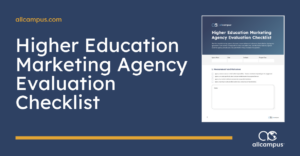
Get your copy of the AllCampus Agency Evaluation Checklist, a one-page reference covering all eight evaluation areas in this guide.
Six Questions That Help Predict Agency Fit
Before shortlisting any higher education marketing agency, ask these questions during discovery conversations.
How do you measure success for a program like ours?
To put it bluntly, success means enrolled students, not impressions, clicks or even leads. An agency that leads with engagement metrics is already demonstrating a different orientation than one that leads with cost-per-enrolled-student.
If an agency can’t speak fluently about cost per enrolled student in your first conversation, that’s worth noting.
How have you handled a campaign that wasn’t performing?
What you’re looking for is honesty and a problem-solving framework. Agencies that struggle with this question tend to be better at appeasing clients than managing campaign performance.
The right answer to this question includes specific changes they made, what they learned and what happened as a result.
Who will actually work on our account?
Many big agencies win business with senior talent, but deliver with junior teams. Ask who will be on the actual account team before you sign. In some cases, there will be a launch team and a team that takes over once your assets are live. This isn’t a bad thing, but you should find out:
Who will handle the day-to-day execution
What the transition plan will be
How much senior involvement you can expect once the relationship is underway
Can I see a sample report before we finalize anything?
Good reporting answers the questions your team actually needs to make decisions. Before signing, ask to see an example of what you’d receive: a sample dashboard, a monthly performance report, a summary of how overall annual performance is communicated. If those materials are clear, current and connected to enrollment outcomes rather than just marketing activity, that’s a good sign.
In a fee-for-service arrangement, take a few minutes to identify the specific data points that matter most to your institution and confirm that reporting covers them:
Lead volume by source
Cost trends
Conversion rates
Enrollment outcomes
In a revenue-share arrangement, the focus should be on the communication cadence:
How often you’ll receive updates
What the monthly reporting covers
How the annual performance review is structured
An agency with real skin in the game is motivated to keep you informed because their success is tied to yours. What you’re confirming is that the infrastructure for that communication is clearly in place before you commit.
What are the contract terms, and how do they reflect your investment in our program?
Contract length should be understood in the context of the financial model and realistic performance expectations.
Revenue-Share Agreement
In a revenue-share arrangement, the agency is making a real upfront investment in program launch, marketing spend and operational infrastructure before receiving any return.
It’s also worth understanding that year one performance is typically limited by time in market. Building search visibility, establishing brand presence in a new program category and developing a qualified inquiry pipeline all take time to compound. Programs that launch faster reach meaningful enrollment performance sooner, which is one reason speed to market isn’t just an operational detail. It affects the entire performance timeline.
Breaking even on the agency’s initial investment typically takes until year three, which is why a five-year contract isn’t a red flag in this context. It’s the structure that makes the economics work for both parties and gives the program enough runway to reach performance levels that justify the investment.
Fee-for-Service Agreement
In a fee-for-service arrangement, shorter terms are appropriate because the institution is paying directly for services rather than asking the agency to fund the launch. The right question isn’t whether the contract is long or short, but you should ask:
Is the partner transparent about why the term is structured the way it is?
What does year one performance realistically look like?
What do the projected economics look like for your institution at each stage?
How do you handle regulatory compliance for student outreach?
Any agency conducting outreach to prospective or current students on your behalf is doing so under your institution’s name. That means TCPA compliance, FERPA regulations, proper consent practices and clear identification of the agency as a third party working with your institution, are your responsibility as much as theirs.
Ask the agency to walk you through how they document consent, how they identify themselves in calls and texts and how they stay current on Department of Education rules governing student recruitment by external vendors. An agency that handles this well will answer without hesitation. One that hasn’t thought carefully about it is a major compliance risk you’d be absorbing.
Get your copy of the AllCampus Agency Evaluation Checklist, a one-page reference covering all eight evaluation areas in this guide.
Revenue Share vs. Fee-for-Service
The business model of a higher education marketing agency shapes almost everything about how they work. Revenue-sharing models, where the agency takes a percentage of tuition from enrolled students, create strong incentive alignment on volume. At the same time, universities and their partners often need to navigate important questions around academic rigor, enrollment alignment and institutional control over marketing decisions.
Fee-for-service models give universities more control but require clearer performance accountability built into the contract. The risk is that a fee-for-service agency optimizes for activity rather than outcomes if success metrics aren’t precisely defined.
Neither model is inherently better. The right choice depends on your institution’s risk tolerance, the maturity of your enrollment operations and how much bandwidth you have to actively manage the relationship. What matters is that you understand the incentive structure before you sign and that the contract includes accountability mechanisms that counteract its weaknesses.
Hold the Right Partner Accountable for the Right Things
A useful rule of thumb when evaluating any agency or partner: accountability should match responsibility. A marketing team that generates leads but has no role in how those leads are handled after they’re submitted cannot fairly be held accountable for enrolled students. If the leads go into a black box and the institution’s own admissions team or a separate vendor handles everything from that point forward, enrollment outcomes reflect the whole system, not just the marketing that feeds it.
This matters practically. If enrollment falls short, you need to be able to diagnose where the breakdown happened. Was it insufficient lead volume? Poor lead quality? Slow follow-up? Application drop-off?
You can only answer those questions if one partner is clearly accountable for the full journey from first inquiry to enrolled student. Partners who accept that accountability and have the operational scope to support it are the ones structured to drive results and explain them when something isn’t working.
The cleaner the scope of accountability, the cleaner the conversation when you’re reviewing performance.
What a Strong Agency Agreement Looks Like
A well-structured higher education marketing agency agreement should address four areas clearly before you sign.
Performance Benchmarks That Match the Scope of the Engagement
In a revenue-share arrangement, benchmarks should reflect enrollment trajectory against the pro forma projections both parties agreed to at launch, with a defined process for reviewing and adjusting them as data accumulates.
In a fee-for-service arrangement, benchmarks can be tied more directly to specific campaign metrics and cost-per-enrollment targets (assuming they’re working leads through the funnel) because the agency is accountable for a defined deliverable rather than a shared investment.
Reporting Structure and Cadence
In a revenue-share arrangement, confirm the reporting cadence: what the dashboard includes, when monthly reports are delivered and how the annual performance review is structured. The agency has financial incentive to perform. Your job is to make sure the communication channels that let you assess that performance are clearly established from the start.
In a fee-for-service arrangement, define the specific data you need and confirm it before signing by reviewing sample reports.
Clear IP Ownership Language
When your institution directly pays for creative assets, campaign materials and audience data, those deliverables should belong to you at the end of the engagement, regardless of which party produced them.
If, however, the agency developed these assets as part of its own upfront investment (as is common in revenue share agreements), ownership could stay with the agency, since the institution didn’t cover those costs directly. This is something to consider when entering into revenue share relationships.
Contract Terms That Reflect the Financial Model Honestly
A multi-year commitment in a revenue-share reflects the real economics of a model where the agency is investing upfront capital and needs time to generate a return. A five-year term is common and, when the projected enrollment trajectory is clearly laid out, entirely reasonable.
Fee-for-service arrangements can and often should have shorter terms. The key is that the duration is explained in the context of the financial model rather than as a standard practice.
The Right Timeline for Evaluation
University procurement cycles are often slow, but agency evaluation shouldn’t be rushed in ways that skip the questions above. A 60-to-90-day evaluation process that includes structured discovery conversations, reference checks with current clients and a review of sample reports and dashboards will give you far more information than a 30-minute pitch meeting.
Ask to speak with two or three universities that the agency currently works with, ideally ones running programs similar to yours. Ask those references the same five questions above. The answers will tell you more than any case study.
How To Ensure You Make the Right Call
Choosing a higher education marketing agency is one of the higher-stakes decisions an enrollment or marketing leader makes. The right partner can meaningfully accelerate enrollment growth. The wrong one costs money, of course, but also institutional momentum or reputation that’s often harder to recover.
The most effective way to avoid a bad outcome is to invest more time evaluating before you sign and less time renegotiating afterward. The framework we’ve discussed won’t guarantee a perfect outcome, but it will tell you a great deal about whether an agency is the kind of partner worth trusting with your enrollment goals.
AllCampus Agency Evaluation Checklist
Download the AllCampus Agency Evaluation Checklist, a one-page reference covering all eight evaluation areas in this guide, with space to capture what each agency actually says. Bring it to your next discovery conversation.
AllCampus grows enrollment for colleges and universities at a lower cost to serve. AllCampus delivers five core solutions for universities — market intelligence and program strategy, marketing, recruitment, learning design and student success — that support online, hybrid, and campus-based programs across 150+ programs at 30+ partner institutions. Institutions can engage AllCampus across all five areas or focus on the one or two where they need the most support, backed by structured reporting, disciplined operating workflows and measurable enrollment outcomes.